
Category
Daily Word Games
Daily word games as a habit: how long each takes, when to play, what order to try, and why one shared puzzle is worth comparing with friends. Free, no signup.
Last updated: 2026-11-14
Listed games
4 games
Games
Play daily word games
About daily word games
4 daily word games, each with its own angle: Wordgy, Limina, Poople, Clueffy.
More to try — Wordgy, Limina, Poople, Clueffy. Try Wordgy
Daily word games are where the puzzle is made of language itself. All four post one shared answer each day, run free in the browser and ask for no account, yet the thinking barely overlaps: a chain of words down a board, a clue about letter order, riddles that deepen with every miss, and the shortest ladder between two visible words. This page is about using the category — the time, timing, order, streaks and shared results. The rules are compared line by line elsewhere.
Four different mechanisms
Wordgy opens on a board of rows rather than a single empty grid. Each row hides one word of a chain, the first row shows its starting letters, and every later row unlocks only when the one above it is solved. A guess has to extend the letters already revealed on the active row, building left to right; a match extends the chain and hands play to the next row, while a miss counts against that row. You get one hint per row, and once the daily board is finished you can build chains of your own to send to friends. The skill is planning several words ahead, not eliminating letters from a fixed-length answer.
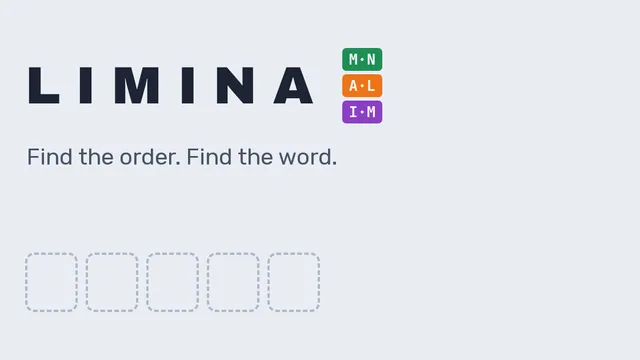
Limina removes position from the feedback entirely. You type a valid five-letter word and a wrong guess returns a coloured pair of letters whose only meaning is that one comes before the other in the answer; you never learn where either letter sits. A guess earns a clue only when it shares two or more letters with the hidden word, so a broad opener made of common, distinct letters beats a clever near-miss. Practice puzzles are generated on demand and leave your streak alone. Six guesses is the whole budget, and the work feels closer to proving an ordering than to spelling.
Clueffy starts with a sentence instead of a blank row. Five progressive clues point at one common six-letter word, and each wrong guess reveals another one. Colour feedback is still there — green for a letter in the right spot, orange for one that belongs elsewhere, dark for one that is absent — but the written clues carry the double meanings and wordplay that a grid cannot express. A wrong length, an unrecognised word or a duplicate does not cost a chance. Five guesses, no timer, and interpretation matters as much as vocabulary.
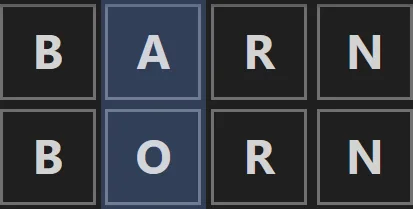
Poople is a ladder, not a guessing game. A numbered daily puzzle gives you a four-letter start word and a fixed target, POOP, and you change exactly one letter at a time until the chain arrives. Every step must be a real four-letter word the game accepts and must differ from the previous word in one position only. There is no hidden answer to uncover: both ends are visible, and the score is how few steps you took. A detour is never fatal, it simply costs you a move. The start word changes daily, so everyone works from the same place.
The rules in brief
Two games fix an answer length and two do not; budgets run from a hard count to steps in a ladder, and feedback from colour tiles to written clues. Rules compared line by line: see Games Like Wordle.
What a day of word games costs
Our cards give all four the same five-minute estimate. That is our own rough guide, not a published figure, and it hides a real spread: treat it as a budget for the habit, not a promise about one board.
Wordgy calls a board a few minutes of work; Clueffy calls its daily a warm-up you can finish in about a minute. Limina spends its time on a limited set of guesses, while Poople has no clock and no fixed number of tries, so a quick solve can stretch once you hunt for a shorter route.
When each one fits in a day
The reset times are the only hard schedule. Limina changes at local midnight and Clueffy at 00:00 UTC, so the same clock applies wherever you are. Poople publishes a new starting word daily without naming an hour; Wordgy has no published reset time in our records, so we do not guess one.
A fixed UTC reset is an appointment you can take before work; a local midnight reset suits the end of the day. The other two are sometime-today puzzles. A one-minute warm-up fits a queue, a board of rows wants a longer sitting. These are our suggestions from the published clocks.
A sensible order to play them in
Start with Clueffy — a written clue warms up reading meanings, and it is short enough not to sour the rest. Then Limina, while you are still strict: its ordering clues reward a broad opener, and arriving with riddle instincts makes you read too much into a pair of letters.
Poople comes third, because a ladder with both ends visible turns finding an answer into finding a route. Leave Wordgy for last: a board of chained rows is the longest sitting and asks you to plan ahead. If you only have a minute, play just Clueffy.
Streaks, practice and the days you miss
Wordgy, Limina and Poople all track streaks. Clueffy's site says progress is stored locally in the browser and its FAQ does not name a streak counter, so we do not credit it with one.
Wordgy Unlimited serves every past board without touching your streak, and its chain maker builds puzzles for friends. Limina offers free on-demand practice, a Challenge Mode called Ante Up and friend sharing. Poople publishes the shortest path for the previous day. Clueffy keeps an answer archive by UTC date, but that is a record of answers, not a replay mode. We host none of it; we list the rules and link to the official games.
Why the same puzzle is worth comparing
A shared daily puzzle gives everyone the same start and clock, so a result means something without a leaderboard: clues needed in Clueffy, guesses left in Limina, extra steps in Poople, hints and misses in Wordgy. Each is checkable without being told the answer.
That is why spoilers matter — naming the word ruins the comparison, naming the score does not. Chain maker, friend sharing and the published shortest path all let a group swap outcomes afterwards. We host no scores or accounts; the habit lives in whatever chat you use, and the reset makes it repeatable tomorrow.
Where to go next
For the Wordle-like tests, letter counts, guess budgets, feedback and reset times set out line by line, see Games Like Wordle. This category stays with the practical half: time, timing, order, streaks and why a shared puzzle is worth talking about. Every game here is free, needs no signup, and links to its official site from its own page.
Daily Word Games FAQ
What is a daily word game?
A puzzle built around letters or words that posts one shared answer each day. You get a limited number of attempts, feedback after each one narrows what the answer can be, and the board resets once every twenty-four hours so a result can be compared without spoiling it.
How are Wordgy, Limina, Clueffy and Poople different?
Wordgy is a board of chained words that unlock row by row, Limina reports only the order of two letters and never their position, Clueffy adds written riddles to colour feedback, and Poople is a four-letter ladder between two visible words. Same daily rhythm, four different kinds of thinking.
Can I play past puzzles again?
It depends on the game. Wordgy Unlimited serves every past board and leaves your streak alone. Clueffy keeps an answer archive with yesterday's word and earlier puzzles by UTC date, but that is a record of answers rather than a replay mode. Limina offers free on-demand practice and a Challenge Mode instead of old dailies, and Poople publishes the shortest path for the previous day. This directory links to the official games; it does not host their archives.
Do these games help build vocabulary?
They exercise different parts of word knowledge rather than teaching word lists. Clueffy asks you to read double meanings in written clues, Limina makes you reason about letter order, Poople rewards knowing bridge words that differ by one letter, and Wordgy asks for words that fit a growing chain. None of them gives definitions or a vocabulary score; the practice is recalling and testing real words under a small daily budget.
Which daily word game should I start with?
Limina if you like pure deduction on a small word list, Clueffy if you enjoy riddles and wordplay, Wordgy if you would rather solve a whole board than one word, and Poople if you want a puzzle with no hidden answer at all. All four are free in the browser.
Do these games need an account or payment?
No. All four run free in the browser with no account or install, post one shared puzzle a day, and keep any streak information locally. We list the rules and the official link on each game page, and the games themselves are played on their creators' sites.