
Play now
mathler.com
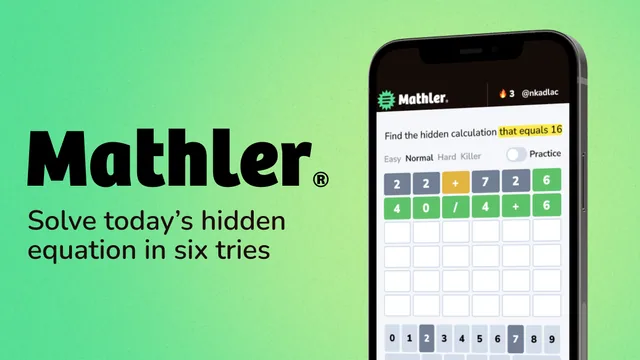
Mathler at a glance
Mathler is a free daily math puzzle where the answer is given and the working is hidden. Each day you get one target number and six guesses to uncover the equation behind it, with green and orange tiles showing which characters belong. A round takes about five minutes, and four difficulty levels plus an unlimited practice mode mean it never runs out.
How to play Mathler
- 1
One target, one hidden equation
Mathler opens with a target number at the top of the board; this is the answer your finished equation must equal, and every one of your six guesses has to hit it exactly or the guess is rejected before it even counts. The row of empty squares underneath shows the exact length of the hidden calculation, so count them first: five squares means the Easy board, six means Normal, and eight with possible parentheses means Hard. Mathler plays free in any browser with no download and no account, so there is nothing to set up before the first guess.
The target number is the answer
- 2
Type a valid equation
Type a first equation using the digits zero through nine and the operators plus, minus, multiply and divide, making sure it equals the target number; order of operations applies, so multiplication and division resolve before addition and subtraction exactly as they do in real arithmetic. A first guess that mixes several different digits and two different operators returns far more information than a repeat of the same characters. If the board is Hard, remember that parentheses may be part of the solution, and a first guess without them still tells you plenty through its gray tiles. The keyboard accepts exactly the characters the puzzle allows, so an invalid equation cannot slip through by accident.
Every guess must compute
- 3
Read green, orange and gray
Submit the guess and read the tile colors: green marks a character in the right spot, orange means the character is in the equation but somewhere else, and gray means it is not in that place, so every guess converts into precise positional information. On the Extreme level the orange hints disappear entirely and only exact matches light up, which changes how each piece of feedback should be read. Commutative solutions are rearranged automatically to match the exact solution, so a mathematically equivalent guess still counts when all its characters are correct.
Positional feedback per character
- 4
Lock greens, relocate oranges
Use what the colors told you to build the next equation, locking green characters where they are and relocating orange ones, until the full hidden calculation is revealed; finish before the sixth guess is spent, then compare streaks and stats with friends. When the board is solved or the guesses run out, the game shows the exact solution and the statistics for that level. A new puzzle drops for each difficulty every day, and the archive holds past boards for replay, so a missed day never breaks the habit permanently.
Six guesses to the solution
Mathler tips and strategy
Open with digit variety
Spend your first guess on an equation built from all different digits and two different operators. A pattern like twelve plus seven minus three tests seven characters at once instead of confirming what a repeated digit already told you. The more characters your opener touches, the more gray, orange and green feedback arrives at the same time, and the earlier the board starts to solve itself. Four difficulty levels mean the same opening discipline scales from the five-square Easy board straight up to Extreme.
Anchor on green tiles
Lock every confirmed character into its exact position before experimenting anywhere else on the board. Greens are the only feedback that never changes meaning between difficulty levels, which makes them the most trustworthy currency in the game. Each new guess should keep all greens untouched and spend its risk exclusively on the squares that are still unconfirmed. With only six guesses in total, disciplined anchoring is what separates a solved board from a near miss.
Bank patterns in practice mode
The unlimited practice mode serves endless equations at your chosen level without touching the daily streak or statistics. Grinding ten practice boards teaches the common solution shapes of each difficulty far faster than one daily per day can. Bring the patterns learned there back to the daily puzzle, where the stakes are real and the streak is on the line. Practice costs nothing, marks nothing, and never touches the daily number.
Respect order of operations
Multiplication and division always resolve before addition and subtraction, so an equation that looks right can evaluate to the wrong target. Mentally recompute each candidate guess before submitting it, from the first character to the last. Most rejected guesses are not wrong characters at all but wrong precedence assumptions stacked into a calculation that never equals the number on screen. Checking precedence twice costs seconds, while a burned guess costs a sixth of the whole board.
Move orange characters
An orange tile proves the character exists in the equation, just not in the slot you tried. Shift it to a different position in the next guess rather than dropping it from the board entirely. Reusing proven characters costs nothing, steadily shrinks where the remaining unknowns can hide, and turns every orange into a fixed clue instead of a loose end. On Extreme, where orange disappears entirely, this habit matters even more because gray alone must carry the deduction.
Mine the archive for shapes
Past daily puzzles stay replayable in the archive for every level, which doubles as a pattern library of real solved equations from previous days. Studying earlier boards shows how often parentheses, doubled digits and repeated operators actually appear in practice. It is the closest thing to an answer book the game offers, and it costs nothing to browse. Browsing old boards is also the fastest way to learn how the writers of the puzzle actually think.
Mathler vs other daily games
Limina
Equations vs. wordsLimina hides a five-letter word and only ever tells you the order of two letters, never their positions. Mathler hides a target number and makes you assemble an equation that lands on it, with colour feedback on digits and operators. Limina is a word puzzle running on sequence logic; Mathler is an arithmetic puzzle running on the same deduction loop. Players who enjoy one usually click with the other, because both replace brute recall with stepwise reasoning. Both post one puzzle a day for everyone, and neither punishes you for thinking out loud before your first guess.
Poople
Deduction vs. crowd matchPoople swaps equations for a word chain: change one letter at a time from a four-letter start word until the ladder reaches POOP. Mathler keeps everything symbolic, asking for a working equation inside a tight guess budget. Poople has no guess limit at all, but each step is constrained to a single changed letter and a real word, and its score counts extra moves beyond the shortest route. One measures arithmetic under pressure; the other measures how cleanly you can plan a path. Both are short daily puzzles where a wrong turn is visible immediately.
Factle
Numbers vs. flagsFactle asks you to rank the top five answers to a question in order, rewarding knowledge of the crowd's consensus. Mathler asks for no crowd at all, just one correct equation built from digits and operators under attempt pressure. Factle is about shared facts; Mathler is about private logic, and a strong Factle player can still stall on Mathler's arithmetic. The two make a balanced pair for players who want both recall and reasoning in one morning. Each game fits inside a short break, and their one-puzzle-a-day rhythm makes them easy to stack in the same morning.
Mathler FAQ
How do I play mathler in my browser?
Open mathler.com in any browser and pick a level: Easy, Normal, Hard or Extreme. The puzzle shows a target number, and each of your six guesses must be an equation that equals it. No download and no account are needed to play the daily board.
How many guesses do I get in mathler?
Six per puzzle, at every difficulty. Each guess must be a valid equation hitting the target number exactly, and tile colors after each guess show which characters are right, present, or absent from that position.
What makes hard mathler different from normal?
Hard Mathler uses eight squares instead of six and allows parentheses in the equation, so expressions with grouped operations become fair game. The guess limit stays at six, which makes every submission count double.
Can I play mathler puzzles from earlier days?
Yes. The archive holds past daily puzzles for every level, so a missed day can be replayed whenever it suits. It also doubles as a pattern library for studying how real equations are built.
How is mathler different from nerdle?
In Mathler you know the target number and hunt for the hidden equation behind it. In Nerdle you guess the entire equation including its answer. Mathler also offers four difficulty levels, unlimited practice mode and a replayable archive.
Is mathler free to play every day?
Yes, Mathler is completely free with no sign-up required. A new puzzle drops for each of the four levels every day, practice mode serves unlimited boards, and the whole thing runs in the browser.
Mathler update notes
2026-11-12
Verified on 2026-11-08 against the official Mathler site and its first-party JavaScript bundle, plus the Wayback Machine record for launch dating. The game runs free in any browser with no sign-up, and every rule quoted above comes from the official how-to-play text inside the bundle.
Mathler is completely free with no sign-up required.
Every guess must be a valid equation that equals the target number.
Four levels: Easy has five squares, Normal six, Hard eight with parentheses, Extreme without orange hints.
A new puzzle drops for each level every day, and the archive replays past puzzles.
Similar games
More daily games like Mathler
Keep exploring nearby daily games from the same category or play style.
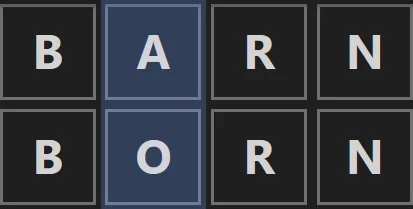
Poople
Change one letter at a time in the Poople word ladder until the chain reaches POOP in as few steps as possible. New start word daily.

Globle
Guess the daily country on a rotating 3D globe in this Globle game, using warmer and cooler hints to close in.
Daily Tens
Name all ten entries on the Daily Tens top-10 list before five wrong guesses, then see your percentile against everyone else.

Wordgy
Solve a board of chained hidden words row by row in Wordgy, spend one hint per row, then build chains to challenge friends.

Timeguessr
Pin a historical photo to the world map, then guess the year it was taken. Timeguessr has solo rounds, duels and archives.
Factle
Rank the top five answers to the Factle question of the day in five tries, with color feedback on every guess.