
Play now
geoconnections.net
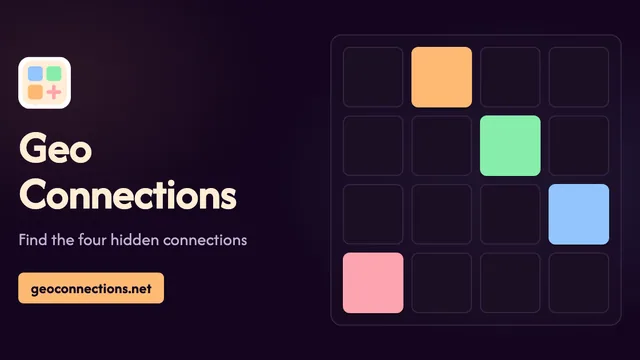
Geoconnections at a glance
Geoconnections is a daily geography puzzle by Teuteuf Games. You get a board of 16 tiles — flags, country names, outlines, capitals, dishes and photos — and your job is to sort them into four hidden groups of four. Each group shares one connection, and the game borrows the grouping idea from Only Connect and the NYT Connections format, pouring real-world geography into that familiar frame.
How to play Geoconnections
- 1
Read all 16 tiles first
To play Geoconnections, open the site in your browser; no account or download is needed, and the same daily board is live for everyone around the world. Before you touch anything, read all 16 tiles slowly and sort them in your head: flags, country names, outlines, capitals, dishes and photos all count as clues. Spend a moment noting which items clearly belong together, because the first confident group becomes the anchor the rest of your solve builds from, and a wrong early guess costs one of your four lives.
Read the 16 clues
- 2
Submit your four
Pick the four tiles you think share one link and press Submit. A correct group locks in, changes colour and reveals its category name, so you can see exactly what connected them and why the author grouped them. If you are wrong you lose one of your four allowed mistakes, so lead with the group you are most sure of and keep the ambiguous tiles in reserve until the safer sets are locked. The board shrinks with every solve, which makes the remaining links easier to spot than they were at the start.
Submit a group of four
- 3
Beware the decoy tiles
Watch for red herrings. Several tiles can look like they fit two groups at once, but every puzzle has exactly one solution, so the square that seems to belong everywhere is usually the designed trap. When you are stuck, open the connection atlas to see the common kinds of links the game likes to use, switch on Easy mode to print the country names under every flag, or press the hint button to reveal one group name. Each hint counts against your score, so save it for the final stubborn set.
Spot the trap tiles
- 4
Solve or use the archive
Keep forming groups until all four are solved or your four mistakes run out. A streak builds as you solve the daily boards in a row, and the full archive lets you replay any past puzzle for extra practice whenever you want more than one solve a day. Compare your result with friends afterwards, since everyone faced the same 16 tiles on the same day, and come back the next midnight local time for a brand new board.
Clear or replay the board
Geoconnections tips and strategy
Anchor the obvious group first
Lead with the set you can name without hesitation, such as four flags that share a colour scheme or four capitals on the same continent. Locking one group early removes four tiles from the board and narrows the field, which makes the trickier links far easier to see than they were at the start. Resist the urge to chase the clever group first, because the easy win builds confidence and frees your attention for the hard part of the board. Naming the category first proves the group is real.
Use the connection atlas
The connection atlas lists the common kinds of links the game likes to use, from shared geography to shared symbols and categories. When you are stuck, skim it before guessing; it reframes the board around the categories the author actually built, which turns a vague hunch into a confirmed group. Treat it as a map of the author's mind rather than a spoiler, and you will spot patterns faster. The atlas beats three blind guesses every time.
Spend hints on the last group
Each hint reveals one group name and counts like a mistake for your leaderboard score, so do not waste them early. Save the hint button for the final stubborn group, when you have already ruled out most combinations and just need the last push to clear the board. A well-timed hint salvages a round you might otherwise lose, while a wasted one leaves you stuck with nothing left. A hint is a loan against your score, not free help.
Save ambiguous tiles for last
Tiles that could fit two groups are the puzzle's pressure points, so do not commit them early. Park them mentally until the other three groups are solved, because a solved board often reveals the single link those stragglers were hiding. Guessing too soon is the fastest way to burn a mistake, and you only get four before the round ends, so patience here pays for the rest of the puzzle. Trust the group you made and set the stragglers aside.
Switch on Easy mode early
Easy mode prints the country names and labels under every flag, outline and photo, which removes the recognition tax for newer players. Turn it on for your first few puzzles so you learn the rhythm of the links without the memory load, then drop it once you can read the tiles by sight and spot patterns on your own. The training wheels are there to be outgrown, not relied on, and the labels can be dropped once a photo unsticks you.
Replay the archive for practice
The full archive of past puzzles is open whenever you want more than the daily board. Replaying older sets trains your eye for the recurring link types, and because every puzzle has exactly one solution, the practice directly sharpens the instinct you bring to the next live round. Treat the archive as your private training ground for the daily, not a lesser consolation prize. The archive teaches the author's favourite tricks fast.
Geoconnections vs other daily games
Globle
Grouping vs locatingGloble asks you to name a mystery country by how close each guess is on the globe, rewarding knowledge of where places actually sit on the map. Geoconnections flips that on its head: you are never naming a single place, only grouping 16 clues into four links. Both are daily geography habits, but Globle tests location knowledge while Geoconnections tests pattern recognition across flags, outlines and landmarks, so the skills you build in one transfer neatly to the other. If you enjoy Globle's daily ritual but want pattern-spotting over trivia recall, Geoconnections is the natural next step.
Noillirk
Pattern vs factsNoillirk deals seven survey prompts and asks for the answer a crowd would give most often. Geoconnections deals sixteen geography tiles and asks which four share a hidden connection. Noillirk is a guessing task about consensus, scored in six tiers; Geoconnections is a grouping task about relationships between flags, landmarks and outlines. Where Noillirk rewards naming the obvious, Geoconnections rewards spotting the category that is not obvious at all. Both run once a day and both are free in the browser.
WhereTaken USA
Daily vs archiveWhereTaken USA shows you a photo and asks you to pin the US state it was taken in, solo or with others. The photo is the whole puzzle there, while in Geoconnections the tiles are the puzzle, a mixed grid of flags and landmarks you must sort. Both are geography daily games, but WhereTaken tests place recognition from imagery and Geoconnections tests connection-spotting across a scattered board, so they scratch different itches. WhereTaken is a solo sprint of recognition, whereas Geoconnections is a slower, more deliberate grouping challenge you can replay from the archive.
Geoconnections FAQ
How do I play Geoconnections?
Open the site in your browser; no account or download is needed. You get a board of 16 geography tiles — flags, country names, outlines, capitals, dishes and photos — and sort them into four hidden groups of four. Pick the four tiles you think share one link and press Submit; a correct group locks in and reveals its category name, and you keep going until all four are solved.
When does the daily Geoconnections puzzle reset?
A fresh puzzle appears every day at midnight in your local time zone, and the same board is live for everyone that day. There is no exact published UTC reset time, but the daily seed means a new set of 16 tiles each day. You can also replay any past board from the archive whenever you like.
How many mistakes can I make?
You are allowed four mistakes before the round ends, so each wrong group costs you one life. If you run out you can reveal the answers or keep going in Infinity mode, which drops the limit for endless practice. Guessing the same four tiles twice never costs a mistake, so do not be afraid to reconsider a group.
Can I replay past Geoconnections puzzles?
Yes. The full archive of every past puzzle is open, so a missed day is never lost and you can replay older boards for extra practice. The daily board is the one that counts for your streak, but the archive is there for anyone who wants more than one solve a day.
What is the connection atlas?
The connection atlas lists the common kinds of links the game likes to use, from shared geography to shared symbols and categories. It is a study aid rather than a hint, meant to reframe the board around the connections the author actually built. Skim it when you are stuck to turn a vague hunch into a confirmed group.
Who makes Geoconnections?
Geoconnections is made by Teuteuf Games, the studio behind Worldle and a range of geography-based games. It was inspired by Only Connect and the NYT Connections format, taking the grouping mechanic and pouring geography into it, so it plays more like a daily geography cousin of those puzzles than a locator.
Geoconnections update notes
2026-11-12
Reviewed on 2026-11-08 against the official Geoconnections site and the game itself, which confirm the four-by-four tile board, the four hidden groups, the mistake limits and the Teuteuf Games studio credit. Geoconnections is a daily geography grouping game: sixteen clues go into four hidden groups of four, with flags, outlines and landmarks mixed into one board. Free hints are limited each day, and an optional Teuteuf Premium plan removes ads across the family of games. The site publishes no exact reset time, so no precise hour is claimed here.
Geoconnections is a daily geography grouping game by Teuteuf Games.
Each board has 16 tiles sorted into four hidden groups of four.
A new puzzle appears every day at midnight local time.
Four mistakes are allowed before the round ends.
Similar games
More daily games like Geoconnections
Keep exploring nearby daily games from the same category or play style.
Globle
Guess the daily country on a rotating 3D globe in this Globle game, using warmer and cooler hints to close in.
Krillion
Krillion gives seven timed prompts and one answer each, scored by how rarely other players would think of your pick.

WhereTaken USA
Guess the US state in the WhereTaken USA photo of the day, then clear the facts, landmark and city bonus rounds.
Factle
Rank the top five answers to the Factle question of the day in five tries, with color feedback on every guess.

Color2
Spot the one recolored region in a Color2 cartoon, logo or Pokemon, then rebuild the shade from memory with HSB sliders.

Timeguessr
Pin a historical photo to the world map, then guess the year it was taken. Timeguessr has solo rounds, duels and archives.